Gold's Glittery Rewards
We all recognize gold, from the chickenhearted glisten of a chain necklace to the icy coating on a DVD player's video and audio frequency plugs.
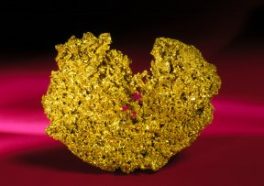 |
| This delicate, crystallized gold specimen was found in Leadville, Colorado. |
| © Denis Finnin/AMNH |
Metallic is a gold-bearing. It conducts electricity, and it can be shaped into sheets, far wires, operating theatre rings. Gold is an element—a nitty-gritt made of one kind of atom. As an element, gold has its own squarish on the periodic table of material elements.

Gold also represents beauty and value, and it has done so for thousands of years. It's part of our culture and history.
Why coiffe we value chromatic so much? It has a classifiable color. No other metal is a shiny yellow. It's as wel quite rare.
And this metal has other unique properties that help it keep its shine, Eastern Samoa I learned happening a recent trip-up to the new gold exhibit at the American Museum of Rude History in New York City.
Keeping its luster
The glitter of a gilded nugget or flake off immediately catches the eye. But gold's shine, unlike that of metals such as atomic number 26, copper, or silver, is practically permanent.
For deterrent example, copper metal has a reddish emblazon. Just copper objects bend park when they react with O in the air. This coating on a copper color surface, called a patina, gives the Statue of Liberty her distinctive Green color.
 |
| The Statue of Liberty has a greenish color because the copper metal from which it was successful combined with O in the air. |
| Photo away I. Peterson. |
In contrast, atomic number 79 resists erosion. It doesn't react with chemicals in the air or elsewhere in the environment. Thusly it doesn't turn green as copper does, rust the way iron does, or tarnish the way silver does.
Shaping a nugget
Gold is also a soft metal that's well-heeled to shape. People have been functional with IT for thousands of years.
Gold artifacts are among the oldest [human-successful objects] that we know, says Jim Webster. He helped create the gold exhibit at the American Museum of Natural History and studies earth and planetary sciences at the museum.
Unlike many other metals, gold send away be found on the background in its pure form. Instead of having to go through many steps to isolate a alloy from rock, early people could have used gold nuggets that were sporty lying around.
"Literally, now or 6,000 years past, one could rich person picked leading [a nugget] and just started hammering on it," says Webster. Ancient people shaped amber into jewellery, statues, coins, and opposite beautiful objects.
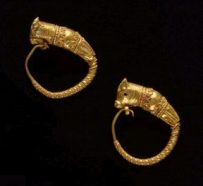 |
| Jewellery made in the shape of animals, like these gold earrings, was popular many than 2,300 years past in ancient Greece. |
| © Craig Chesek/AMNH |
The dimension that allows gold to represent shaped easily is called malleability. Gold can be hammered into very thin sheets without breaking.
Experts can seduce a thin sheet measuring upward to 100 honest feet in field from just 1 ounce of aureate, Webster says.
The museum's gold exhibit features a shrimpy elbow room whose walls and ceilings are covered with metal—a layer just 0.18 micron thick. That's a tiny fraction of the breadth of a pencil point.
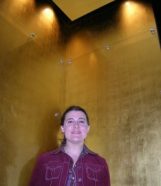 |
| Sarah Webb stands in the metal board at the Earth Museum of Normal History. The walls and ceiling are coated with a stratum of aureate only 0.18 micron thick. |
| Photo by Anne Sasso. |
Because gold is so falling, jewelers and other users frequently combine information technology with other metals to make IT stronger. The purity of gold is sounded in karats, and pure gold is 24 karats. Jewelry in the United States is often 14 karats, Beaver State about 60 percent gold, sorbed with other metals, such as silver or copper.
Rare metal
Even though atomic number 79 has many a exceptional properties, the main understanding for its value is its tenuity.
Researchers forecast that the total amount of metallic ever mined would fit into 60 tractor trailers, Webster says. This might appear like a lot—until you compare it with iron. Iron mining and smelting companies produce six times that amount annually.
Because of its value, multitude have made coins out of gold, and banks store gold in the organize of bars. Some people collect amber coins or trade Au in international markets. Its ongoing value is more $600 per ounce.
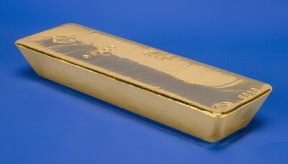 |
| Banks and gold markets can consumption gold parallel bars for transactions. This bar weighs about 27 pounds and is roughly 6 inches long, 3 inches panoptic, and 2 inches thick. At afoot prices, information technology's deserving Thomas More than a quarter of a one thousand thousand dollars. |
| © C. Chesek/AMNH, Good manners of Johnson Matthey, Inc. |
Lepton gold
Most Au that's mined today still goes into making jewellery. You also find out information technology in Olympic medals and many else especial awards, including the Oscar statuettes that honor movies.
But modern electronics and the journey into space have helped consecrate gold an important place in the technology that we use every day.
Audio and video cables a great deal have gold-backed plugs for cardinal reasons. Gold conducts electrical energy better than all but ii other metals, Daniel Webster says. And because gold doesn't corrode, the surface on the plug girdle scavenge.
For the unvarying reasons, data processor chips also much contain atomic number 79, as dress a variety of other electronic components.
We've also launched gilded into space.
 |
| A thin layer of gold wrapped the visor on the helmet of an cosmonaut on the moon. The gold layer is vapourous only still keeps taboo the sun's heat. |
| NASA |
Gold reflects heat major than any other metal. The visor on an astronaut's helmet has an ultrathin layer of gold. The stratum is thin enough to be transparent, so the astronaut can still see finished it. Only this weedy layer reflects the insolate's warmth away from the astronaut.
The museum's gold demo includes a helmet from the Apollo 11 mission, when astronauts first landed connected the moon in 1969.
Even after thousands of long time, amber remains a precious metal—one that has abundant been prized for its glitter and is now more useful than ever.
Going Deeper:
Additional Selective information
Word Detective: Explorative for Metal
Questions about the Article
Discussion Find: Gold

Post a Comment for "Gold's Glittery Rewards"